DailySheet Tamil Calendar
In TestFlight
The traditional Tamil daily sheet — the one that hung on the kitchen wall — rebuilt for your phone, for wherever you live now.
Coming soon — in TestFlight now
Why we built it
In Tamil homes, the day used to begin with a calendar. Yesterday’s sheet was torn away, and before anything else happened, the new day was read. Print is static. Your day isn’t.
Read the story →Only from Dolga
Print is static. Your day isn’t.
Every sheet is computed fresh for where you actually are — sunrise-true times, the full panchangam, and reminders that work out their own future dates. Other calendars photograph a printed page. This one does the math.
About
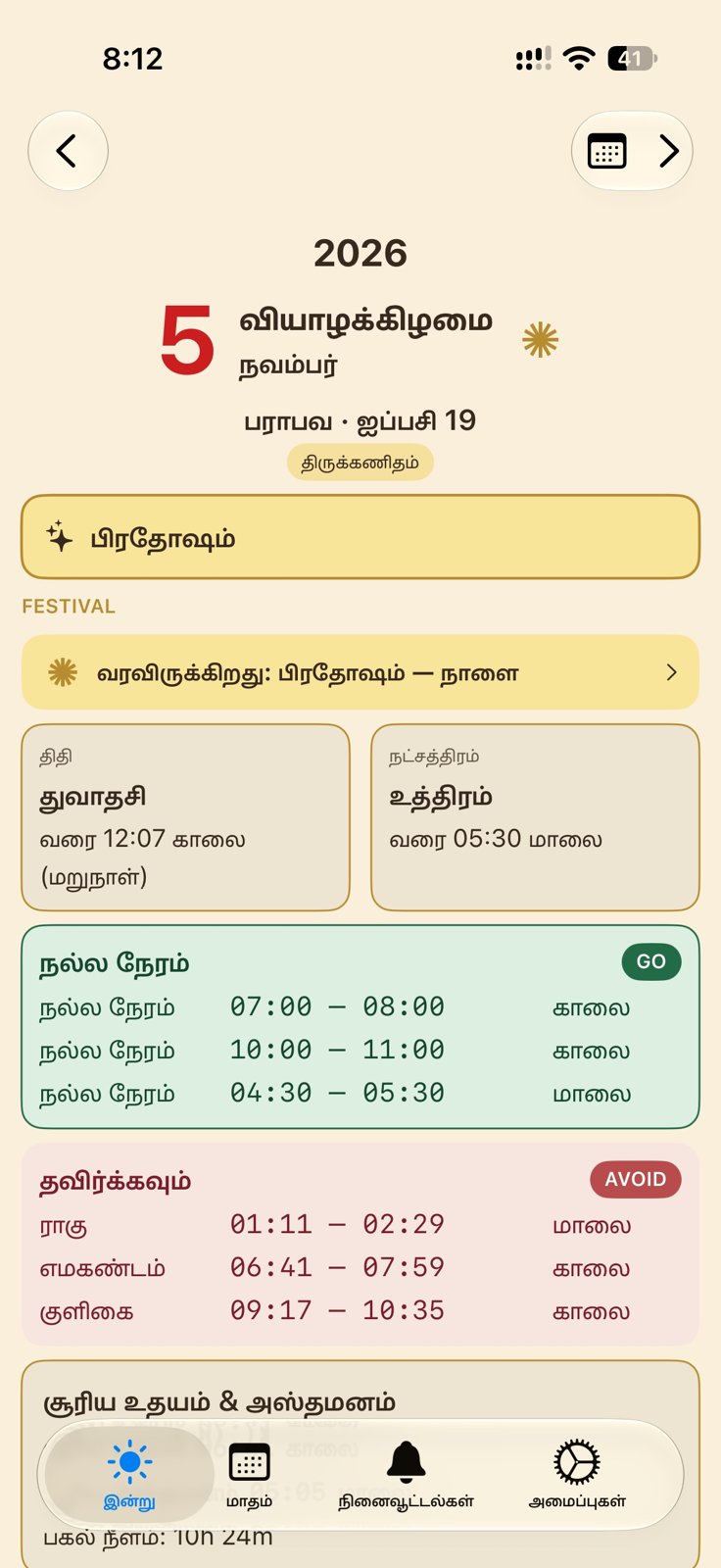
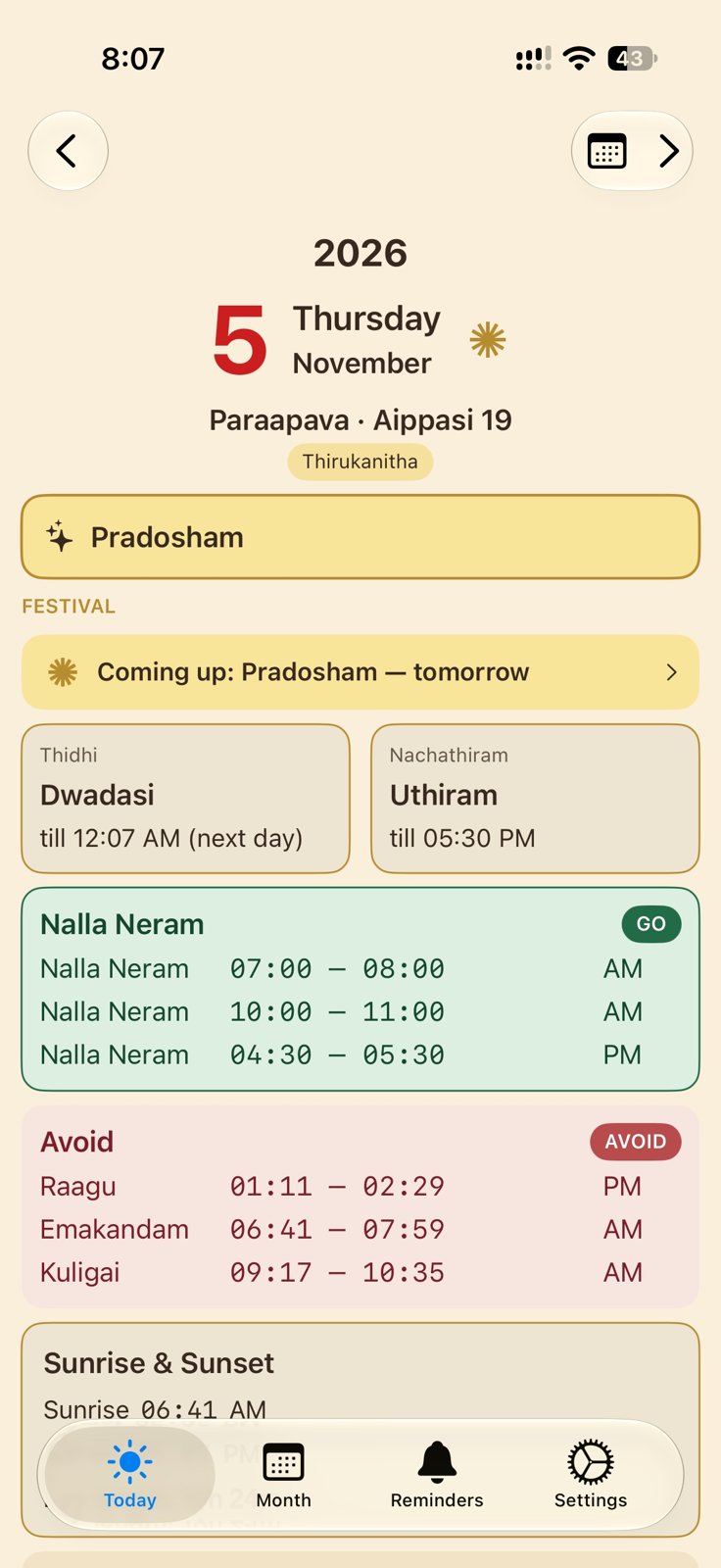
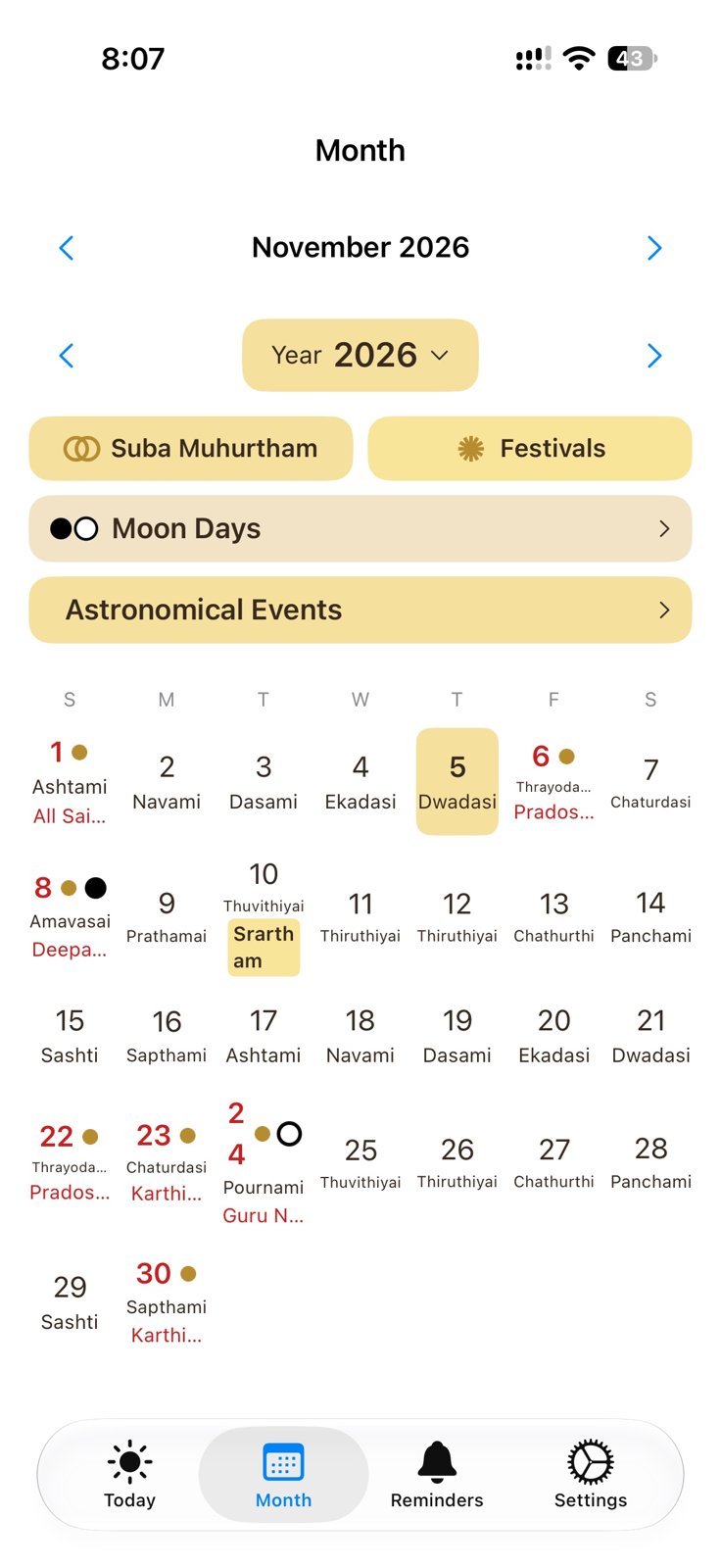
DailySheet Tamil Calendar shows the day the traditional way: Tamil date, thithi and nakshatra with their timings, sunrise and sunset, festivals, and auspicious times — computed on-device for your location, in English and Tamil. Festival and holiday dates are marked in red, the way the printed sheet always did it.
It follows the Thirukanitha system by default (Vakya is available in Settings), marks festivals from every tradition alongside the Tamil calendar, and adds astronomical events — eclipses visible from where you are, Jupiter at opposition, and more.
It is also a panchangam you can find dates in, not just read. The muhurtham days are listed by week, month and year — tap any date and its full sheet opens, computed for your place: the thithi in force at your sunrise, rahu kalam from your day, festival days shifted to where you live. A family spread across time zones checks the same date, and each person sees it computed correctly for where they are.
Paid once. No ads, no in-app purchases, no subscriptions.
Read the story behind DailySheet Tamil Calendar: The Sheet on the Wall →
Features
- The full sheet, every day — tithi, nakshatram, yoga, karana, nalla neram, and the times to avoid — rahu kalam, yamagandam, kuligai
- Computed for your place — sunrise-true times for where you actually are — never a fixed table copied from print
- Checked, not guessed — when published tables disagree on a date, the sheet flags it “double-check” instead of silently picking one, and says openly which tradition it follows
- No yearly pack to renew — any date from 1900 to 2100, computed on-device; paid once, nothing expires
- Festivals + muhurtham days — the year’s important days, marked on the sheet
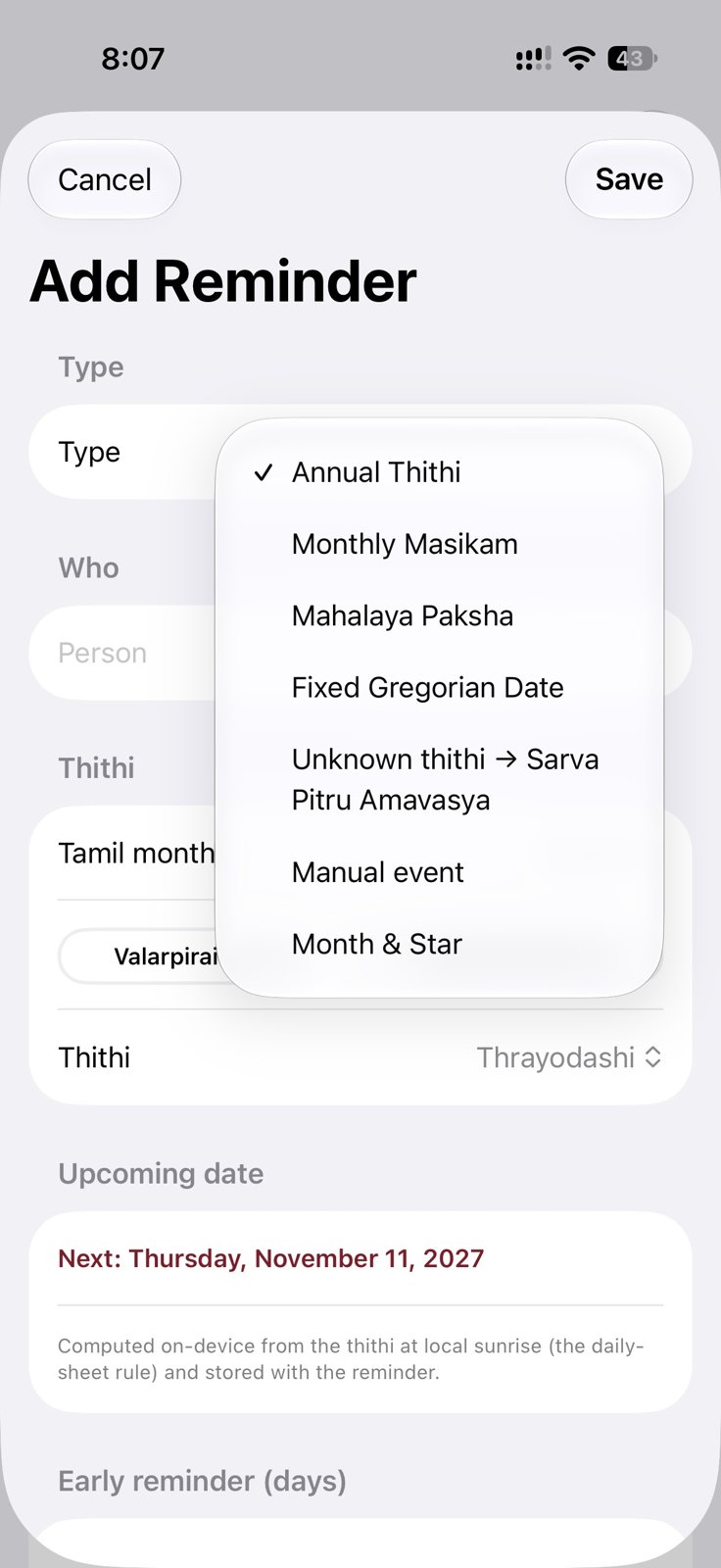
- Reminders that work out your days — set a thithi once — a srartham, a festival, a vratham day — and it computes every upcoming date itself and keeps them ready
- Your temple’s days, kept — temples publish their observances in no standard way — there is no feed to subscribe to. Set the temple’s thithi or star day once, and the sheet works out its date every year, next to your family’s own days
- Sky & astro — sunrise and sunset for your place, plus an astronomical events list — eclipses and more
- Widgets — Home Screen small and medium, plus Lock Screen tithi and nakshatra
- Tamil + English — the full sheet in both; Thirukanitha by default, Vakya available
How it works
Location used
All panchangam times on the daily sheet are computed for this location (GPS or city pick, on-device). The location is shown here only, not on the daily sheet.
Tradition in use
Thirukanitha: computed on-device (Meeus/Schlyter, Lahiri ayanamsa). Vakya: traditional tables to be verified against a published Vakya almanac — values shown are Thirukanitha-computed for now (Meeus/Schlyter, Lahiri ayanamsa). Change it in Settings. Dates recompute when you switch.
Moon Days
Moon days are computed on-device from the astronomical engine, not from a published moon list. Amavasya is the day the Amavasai tithi prevails at local sunrise; Pournami is the day the Pournami tithi prevails at local sunrise. Boundaries are good to roughly 1–2 hours, not to the minute, and a tithi boundary near sunrise can shift the day.
Astronomical Events
Astronomical events are computed on-device from the astronomical engine (Meeus/Schlyter, Lahiri ayanamsa; planetary positions by Schlyter; eclipses by Meeus), not from a published list. Types: supermoons, micromoons, blue moons, solstices, equinoxes, planetary conjunctions, oppositions, greatest elongations, and eclipses. Per-type toggles are in Settings only. Eclipse visibility is an approximate on-device check: lunar visibility means the Moon is above the horizon at greatest eclipse; solar visibility means the observer is within the approximate penumbra reach and the Sun is up. A solar eclipse whose global type is total or annular may be only partial from your location, and totality is not promised. Event times are approximate, not to the minute — confirm eclipse visibility with a local source before planning. ISS passes are not included: they need fresh orbital data and are not purely calculable. Astronomical Events, Festivals, Suba Muhurtham dates, and Moon Days are separate categories and are never merged.
Reminders & iCloud
Manual reminders (srartham and other manual events) are saved on this device and synced to your private iCloud only — your Apple ID, private database. Never to a Dolga server, never shared with other users. iCloud sync is ON by default; turn it off anytime in Settings — off is respected and never auto re-enabled — and reminders still work fully on this device. Each reminder’s upcoming date is computed on-device (thithi at local sunrise) and stored with the reminder, here and in its iCloud record; it refreshes when the date passes, when the place changes, and after every sync.
Suba Muhurtham
Suba Muhurtham dates are published Tamil tradition dates, 2026–2028, dates only — no muhurtham times shown. They are not computed for your location, and web lists reproduce a common Tamil calendar list rather than independently verifying it. Dates marked Double-check have conflicting or single-source listings — please double-check with your almanac or priest before fixing a wedding date. The 22 Jan 2028 weekday is corrected to Saturday. This table will be replaced when a better verified source is available. 17 Sep 2026: the Gregorian date is listed, but its Tamil month label differs between lists (Avani 31 vs Purattasi 1) — no Tamil label is shown for this date until an almanac resolves it.
Festivals
Festivals are computed on-device by rule, for all religions: fixed solar dates (Christmas Dec 25, Vaisakhi Apr 14, Naw-Rúz Mar 21), Easter by computus, Jewish by Hebrew calendar rules, Hindu/Tamil solar and moon rules from the engine (Thai Pongal, Tamil New Year, Karthigai Deepam, Holi, plus the published Deepavali / Maha Shivaratri / Navaratri Begins dates above), Buddhist Vesak and Sikh Guru Nanak Jayanti by full-moon rules, Islamic by tabular Hijri as PREDICTED. Islamic dates depend on moon sighting and may differ by a day; Jewish days begin at sundown the previous evening (daytime date shown). Deepavali is a published 2026–2028 Tamil date, marked Double-check: Tamil Nov 8 2026, Oct 28 2027, Oct 16 2028 (Naraka Chaturdashi morning); North India observes Amavasya evening Nov 8 2026, Oct 29 2027, Oct 17 2028 — confirm with your almanac. Maha Shivaratri (night-observed, published 2026–2028: Feb 15 2026, Mar 6 2027, Feb 23 2028) and Sharad Navaratri Begins (published 2026–2028: Oct 11 2026, Sep 30 2027, Sep 19 2028) are also added; Ash Wednesday, Easter Monday and Pentecost follow Easter computus, and Ridván Begins is Apr 21 fixed. Jain Mahavira Nirvana is still omitted, not guessed, because its timing rule varies by tradition. Tamil-based focus (Oct 25, 2026): South India and Tamil Hindu/Brahmin festivals are prioritised; other religions are included, not an exhaustive all-India list. Tamil Hindu items are labelled Tamil Hindu; Onam and Vishu are labelled Kerala and Ugadi Telugu / Kannada — never presented as Tamil festivals. New rule-based Tamil/South items: Bhogi, Mattu and Kaanum Pongal around Thai Pongal; Aadi Perukku (18th day of Aadi), Aadi Amavasai, Aadi Pooram (Andal Jayanthi falls on this day); Avani Avittam by the Yajur rule (Pournami at midday in Avani; Rig Upakarma is the Shravana-nakshatra day, Sama is later); Krishna Jayanthi (Krishna Ashtami in Avani, Rohini preferred); Vinayaka Chaturthi (Chaturthi at midday in Avani); Saraswati Puja and Ayudha Puja on Navaratri day 9 and Vijayadasami on day 10, Tamil Nadu observance (some traditions a day later, hence Double-check); Thiruvathirai (Arudra Darshan, Margazhi); Panguni Uthiram; Chitra Pournami (Pournami in Chithirai); Vaikunta Ekadasi (Ekadasi in Margazhi); Thaipusam (Pusam at midday in Thai; in 2028 Pusam prevails at no Chennai sunrise); Vaikasi Visakam; Onam (Thiruvonam at midday in Chingam); Vishu (first full day of Medam — some Kerala calendars mark the Sankranti day instead, hence Double-check); Ugadi (Prathamai in Meena, with the Amavasya-day clause for 2026). Festivals, Suba Muhurtham dates and Moon Days are separate categories and are never merged. Indian-tradition festivals (Thai Pongal, Tamil New Year, Karthigai Deepam, Holi, Vesak, Guru Nanak Jayanti) are computed at Chennai sunrise, as those traditions are anchored there; your sheet’s tithi/nakshatra are still computed for your location. Tamil vratham and nonbu (added October 2026): Varalakshmi Vratham is the Friday before Shravana Pournami (the Aavani full moon) — in 2026 the Pournami itself is a Friday, so Tamil calendars mark August 21 while some lists mark August 28, hence Double-check. Karadaiyan Nonbu is the Masi-to-Panguni transition (Meena Sankranti panchang day). Kedaara Gowri Vratham is the 21-day vratham concluding on Deepavali Amavasya evening. Aadi Velli is every Friday of Aadi and Karthigai Somavaram every Monday of Karthigai. Pradosham is the evening (Pradosh Kaal) Trayodashi of both pakshas, Chennai-anchored: computed with Chennai sunsets, not your city’s, so near a tithi boundary the day can differ from a sunrise-rule list or another city’s almanac, hence Double-check. Sri Rama Navami is Chaitra Shukla Navami. Hanuman Jayanthi follows the Tamil tradition — Margazhi Moolam; some Tamil almanacs mark the Margazhi Amavasya day instead, and North India marks Chaitra Purnima, a different observance. Bodhayana Amavasya is observed by families following the Bodhayana sutra - including Tamil Brahmins and Telugu Brahmins - one day before the general Amavasya in months when the Amavasya tithi has begun before sunset on that earlier day (Chennai-anchored; for example Feb 16, 2026); in other months it coincides with the general Amavasya and is not listed separately. It is not Sarva Pitru / Mahalaya Amavasya, which is one specific month’s Amavasya. Drik Panchang publishes no Bodhayana list to cross-check, so Bodhayana rows are marked Double-check. Confirm religious observance dates with your almanac or priest.
US dates (Drik)
US users: the reference is Drik Panchang computed for your US city. Hindu/Tamil festival dates in this app are computed from a Chennai anchor, not yet from your city’s sunrise — cross-check (Oct 25, 2026) found these Drik US dates differ from the dates shown: Pongal set 2026 — Bhogi Jan 13, Thai Pongal Jan 14, Mattu Jan 15, Kaanum Jan 16 (app shows Jan 14-17); Sri Rama Navami 2026 — Mar 26 (app shows Mar 27); Tamil New Year 2027 — Apr 14 (app engine gives Apr 15); Karthigai Deepam 2027 — Dec 11-12 across sources (app gives Dec 13). In the US, Naraka Chaturdashi is a separate day, Nov 7, 2026, before Deepavali on Nov 8. Those rows are marked Double-check when your location is not Chennai. Maha Shivaratri, Krishna Jayanthi, Vinayaka Chaturthi and Deepavali 2026 matched Drik US dates. Thithi reminder dates ARE computed at your own sunrise, so they follow the US reading already. Confirm with Drik Panchang for your city or your temple.
What DailySheet Tamil Calendar uses
- Location — or a place you pick — the sheet is computed for it, sunrise-true
- iCloud — your reminders sync through your own iCloud, under your Apple ID, where we cannot see them
- Nothing else — no Game Center, no accounts, no analytics
Full details in our privacy policy.